You use one hand for almost everything. Writing, eating, brushing your teeth, opening doors, throwing a ball. Your dominant hand handles roughly 90 percent of daily motor tasks while your non-dominant hand assists. This feels natural and efficient, but it comes with a hidden cost: your brain is only exercising half its motor capacity.
Non-dominant hand training is the practice of deliberately using your weaker hand for everyday tasks and skilled activities. It sounds trivial. The neuroscience behind it is anything but.
1. It Forces Neuroplasticity in Ways Nothing Else Does
When you perform a familiar task with your dominant hand, your brain operates on autopilot. The neural pathways for that movement are well-established, efficient, and require minimal cognitive resources. Your brain is barely working. Switch to your non-dominant hand, and everything changes.
Your brain must now recruit entirely different neural networks. The motor cortex on the opposite hemisphere activates. New motor maps must be constructed from scratch. Error correction systems fire continuously as your hand fumbles through movements that your other hand performs effortlessly. This is neuroplasticity in action, the brain building new connections in response to novel demands.
A 2018 neuroimaging study at the Max Planck Institute found that just two weeks of non-dominant hand practice produced visible changes in white matter connectivity between the brain's hemispheres. Participants who practiced writing and fine motor tasks with their non-dominant hand showed increased corpus callosum density, improving the speed and quality of communication between the left and right brain.
This kind of structural brain change is exactly what cognitive decline erodes. Hand-eye coordination exercises that emphasize the non-dominant side are among the most efficient ways to force the brain into growth mode.
2. Bilateral Coordination Strengthens the Whole Brain
The brain is not two independent halves. It is a deeply interconnected system where the left and right hemispheres constantly share information through the corpus callosum, a bundle of over 200 million nerve fibers. When both hemispheres are actively engaged, cognitive performance improves across the board.
Non-dominant hand training is one of the most direct ways to strengthen bilateral coordination. Activities that require both hands working together, like catching and throwing with alternating hands, playing a musical instrument, or kneading clay, force the corpus callosum to work harder than single-hand tasks ever do.
Research from the University of New South Wales found that adults who practiced bilateral hand tasks for eight weeks showed significant improvements not just in motor skills but in attention, working memory, and cognitive flexibility. The brain did not just get better at hand movements. It got better at thinking.
3. Daily Activities Become Brain Training
The beauty of non-dominant hand training is that it requires no special equipment, no gym membership, and no dedicated time block. You train your brain by doing things you already do, just with the other hand.
Start with low-stakes tasks that do not involve sharp objects or hot surfaces:
- Brush your teeth with your non-dominant hand
- Stir your coffee or tea with the opposite hand
- Use your mouse or trackpad on the other side
- Open doors with your non-dominant hand
- Eat with utensils in the opposite hand
- Throw and catch a ball with your weaker hand
Each of these tasks feels awkward at first, which is precisely the point. That awkwardness is your brain working hard to build new motor maps. Over days and weeks, the awkwardness fades as new neural pathways strengthen, but the cognitive benefits persist.
"The brain is like a muscle. When we use it in new ways, it grows. When we rely on old habits, it atrophies." — Dr. Michael Merzenich, pioneer of neuroplasticity research
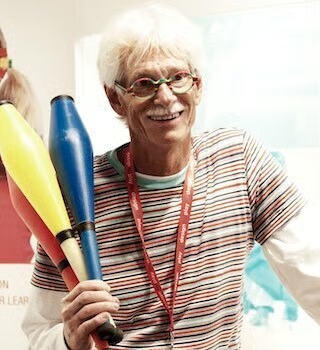
Stephen Jepson, the creator of the Never Leave The Playground movement philosophy, made non-dominant hand training a cornerstone of his daily practice. He practiced throwing, catching, writing, and eating left-handed until both sides of his body were nearly equally skilled, demonstrating that executive function improves alongside physical dexterity.
4. The Improvements Are Measurable and Lasting
Non-dominant hand training is not a vague wellness suggestion. The cognitive improvements it produces are measurable with standard neuropsychological tests and brain imaging.
A controlled trial at the University of Bern assigned 60 adults over age 55 to either a non-dominant hand training group or a control group for twelve weeks. The training group practiced fine motor tasks with their non-dominant hand for 15 minutes daily. At the end of the study, the training group showed statistically significant improvements in processing speed (11 percent faster), working memory (8 percent improvement), and cognitive flexibility (14 percent improvement on trail-making tests).
Perhaps most importantly, follow-up testing at six months showed that participants who continued even minimal non-dominant hand practice retained their gains. Those who stopped practicing saw their improvements gradually fade, but the decline was much slower than expected, suggesting that the structural brain changes had some permanence.
The practical applications extend beyond cognitive testing. Participants reported feeling sharper in daily life, handling multitasking situations more easily, and experiencing greater confidence in physical activities that required bilateral coordination.
Train Your Brain, One Hand at a Time
Discover more surprising ways to keep your mind sharp at any age.
Browse The 4 ThingsThe Bottom Line
Your non-dominant hand is an untapped brain training tool that you carry with you everywhere. Using it forces neuroplasticity that autopilot tasks cannot trigger. Bilateral coordination strengthens communication between brain hemispheres. Everyday activities become cognitive workouts without any extra time commitment. And the improvements in processing speed, memory, and flexibility are measurable and lasting. The simplest brain training program you will ever find is already at the end of your arm.