Brain training apps generate billions of dollars a year by promising sharper cognition through screen-based puzzles. The irony is that the most powerful brain training tool has been available since childhood and costs nothing: play. Unstructured, physical, sometimes messy play rewires the adult brain in ways that no app or crossword puzzle can match.
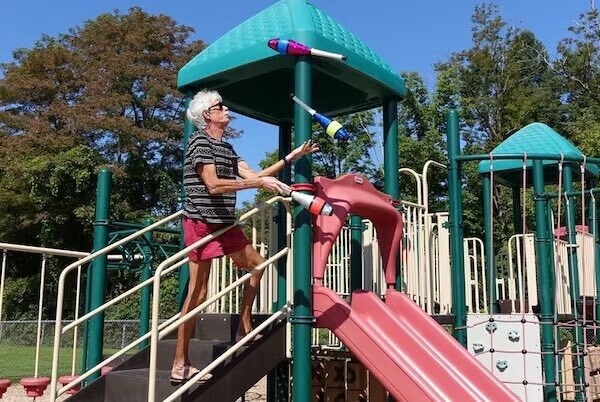
Stephen Jepson, a ceramics professor who became a movement advocate in his seventies, built an entire philosophy around this idea. His approach, called Never Leave The Playground, uses juggling, balance boards, non-dominant hand tasks, and physical challenges to keep the brain building new neural connections well into old age. The science backs him up completely.
1. Play Builds Neural Pathways That Puzzles Cannot
When researchers at the University of Illinois compared physical play-based activities to sedentary brain games, the results were decisive. Physical play that involves coordination, balance, and unpredictable movement stimulates the prefrontal cortex, cerebellum, and hippocampus simultaneously. Screen-based brain games primarily activate narrow, task-specific regions.
The reason is complexity. Catching a ball, walking on a balance beam, or juggling scarves requires your brain to integrate visual processing, motor planning, spatial awareness, and real-time error correction all at once. This multi-system demand forces the brain to build new synaptic connections and strengthen existing ones. A 2019 study published in Frontiers in Aging Neuroscience found that older adults who engaged in coordinative exercise showed greater white matter integrity than those who did traditional aerobic exercise alone.
Activities like hand dexterity exercises are a perfect starting point because they challenge fine motor control while keeping the experience playful and low-pressure.
2. Non-Dominant Hand Training Forces Neuroplasticity
One of the most potent brain training techniques is deceptively simple: use your non-dominant hand for everyday tasks. Brushing your teeth, stirring your coffee, throwing a ball, or writing your name with the opposite hand forces your brain out of autopilot and into active learning mode.
This works because roughly 90 percent of daily motor tasks are handled by well-established neural pathways. Your brain runs them on autopilot, using minimal cognitive resources. When you switch hands, those pathways are useless. Your brain must recruit different neural networks, build new motor maps, and coordinate unfamiliar muscle patterns. Research from the University of New South Wales showed that bilateral hand training increased corpus callosum activity, the bridge between the brain's hemispheres, enhancing communication between the left and right brain.
Stephen Jepson made non-dominant hand training a cornerstone of his daily routine. He practiced throwing, catching, writing, and even eating with his left hand until both sides of his body were nearly equally capable. The cognitive benefits extended far beyond hand coordination, improving his executive function, reaction time, and problem-solving speed.
3. Executive Function Improves When the Body Is Challenged
Executive function is the set of cognitive skills that allow you to plan, focus attention, remember instructions, and juggle multiple tasks. It declines naturally with age, but physical play slows and even reverses that decline more effectively than cognitive training alone.
A landmark 2018 meta-analysis in the British Journal of Sports Medicine reviewed 36 studies and concluded that physical exercise, particularly exercise requiring coordination and decision-making, produced significant improvements in executive function in adults over 50. The effect was strongest when the exercise was complex and unpredictable, exactly the kind of movement that play provides.
Activities like juggling are especially powerful. Learning to juggle three balls requires sustained attention, pattern recognition, timing, error correction, and bilateral coordination. A study at the University of Hamburg found that adults who learned to juggle over a three-month period showed measurable increases in gray matter density in areas associated with visual-motor processing. The gains persisted even after the participants stopped practicing.
"We don't stop playing because we grow old; we grow old because we stop playing." — George Bernard Shaw
The research on juggling and brain benefits is remarkably consistent: physical skill acquisition in adulthood drives structural brain changes that no passive activity can replicate.
4. Stephen Jepson's Approach Proves the Science in Real Life
Stephen Jepson was already in his seventies when he began transforming his property into a personal playground. He installed balance beams, hung ropes, scattered juggling balls, and created obstacle courses. His daily routine included hours of physical play, always with an emphasis on novelty, challenge, and using the non-dominant side.
The results were extraordinary. At an age when most people are managing decline, Jepson was learning new physical skills, maintaining razor-sharp cognitive function, and moving with the agility of someone decades younger. His approach was not based on exercise science textbooks. It was based on a simple observation: children who play constantly are learning constantly, and there is no biological reason adults cannot do the same thing.
Modern neuroscience confirms this intuition. The brain's capacity for neuroplasticity, the ability to form new connections and reorganize existing ones, does not disappear with age. It requires stimulation. And the best stimulation is physical, novel, challenging, and enjoyable. That is exactly what play provides.
Play Is the Best Brain Training
Discover more surprising truths about health, movement, and lifelong learning.
Browse The 4 ThingsThe Bottom Line
Brain training does not require a subscription or a screen. Physical play builds broader, stronger neural pathways than any app. Non-dominant hand training forces your brain to create new motor maps. Complex movement improves executive function more than cognitive puzzles. And Stephen Jepson's real-world example proves that these principles work at any age. The playground is not behind you. It is the most powerful tool you have for keeping your brain sharp for the rest of your life.