Memory is not one system. These four types work together to store skills, facts, experiences, and habits — and each one can be strengthened differently.
1. Episodic Memory: Your Personal Timeline
Episodic memory stores personal experiences — your first day of school, your wedding, where you were during a major event. It is autobiographical, context-rich, and deeply emotional. Episodic memory is what gives you a continuous sense of identity across time. It is centered in the hippocampus and is one of the first memory systems to decline with age.
The richness of episodic memory depends on attention and emotion. Events that are emotionally significant or highly novel are encoded more strongly. This explains why you remember your graduation day in vivid detail but cannot recall a random Tuesday. Novel experiences — travel, new activities, meeting new people — create more episodic memories, which is why time seems to pass more slowly when you are doing new things.
2. Semantic Memory: Facts and Knowledge
Semantic memory stores general knowledge about the world — the capital of France, how photosynthesis works, what a dog looks like, how to read. Unlike episodic memory, semantic memories are not tied to specific personal experiences. You know that Paris is the capital of France, but you probably do not remember the exact moment you learned it.
Semantic memory is more resilient to aging than episodic memory. Vocabulary and world knowledge actually tend to increase throughout life, peaking in the 60s and 70s. This is why older adults often outperform younger adults on general knowledge tests even as they struggle with remembering recent events. Continuous learning and intellectual curiosity — through reading, puzzles, and brain-function exercises — strengthens semantic memory networks.
3. Procedural Memory: Skills in Your Body
Procedural memory stores how to do things — ride a bicycle, type on a keyboard, play a musical instrument, juggle. It is the most durable form of memory and the most resistant to age-related decline. You can forget someone's name five minutes after meeting them, but you will never forget how to ride a bike, even after decades without riding.
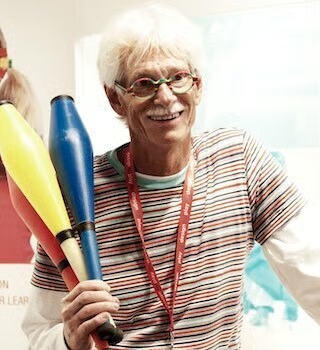
Procedural memory is built through repetition and practice, not conscious study. It is stored primarily in the cerebellum and basal ganglia, separate from the hippocampal systems that handle episodic and semantic memory. This is why people with severe amnesia can still learn new motor skills. Stephen Jepson's daily practice of juggling, balancing, and unicycling continuously builds procedural memory, keeping these motor systems sharp and responsive at 85.
"Memory is the diary that we all carry about with us." — Oscar Wilde
4. Working Memory: Your Mental Whiteboard
Working memory is the system that holds and manipulates information in the moment — following directions, doing mental math, keeping track of a conversation with multiple threads. It has severely limited capacity: most people can hold 4-7 items in working memory at once. When working memory is full, new information pushes old information out.
Working memory is the bottleneck of cognition. It determines how quickly you learn, how well you solve problems, and how effectively you handle complex tasks. Unlike other memory types, working memory can be improved through targeted training. Activities that challenge you to hold multiple pieces of information simultaneously — non-dominant hand training, dual-task exercises, and learning musical instruments — all strengthen working memory capacity.
Keep Exploring
Discover more articles that break life's biggest topics into the essential things that matter.
Browse The 4 ThingsThe Bottom Line
Your memory is not a single system but four distinct ones working together: episodic (personal experiences), semantic (facts and knowledge), procedural (physical skills), and working (moment-to-moment processing). Each type has different strengths, vulnerabilities, and training methods. Understanding how they work empowers you to protect and strengthen the ones that matter most to your life.