Coordination is your brain's ability to control your body precisely. These four types explain how coordination works, why it declines, and how to keep it sharp.
1. Hand-Eye Coordination: Connecting Vision to Action
Hand-eye coordination is the ability to guide hand movements based on visual input — catching a ball, threading a needle, typing on a keyboard, pouring a glass of water. It requires precise timing between visual processing and motor execution, a relationship that the cerebellum fine-tunes through practice.
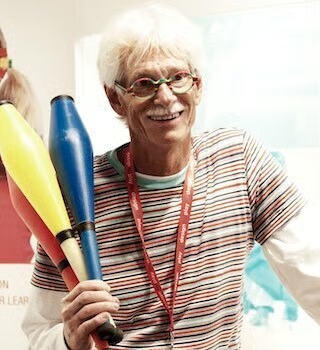
Hand-eye coordination declines gradually after age 50 as processing speed slows and visual acuity changes. But it responds remarkably well to training. Juggling — even learning to juggle with two balls — has been shown to increase gray matter in areas responsible for visual-motor processing. Non-dominant hand training is particularly powerful because it forces the brain to build entirely new hand-eye pathways rather than relying on established ones.
2. Bilateral Coordination: Two Sides Working Together
Bilateral coordination is the ability to use both sides of your body together in a controlled, organized way. It comes in three forms: symmetrical (both sides doing the same thing, like jumping jacks), alternating (sides taking turns, like walking or climbing stairs), and asymmetrical (each side doing something different, like stabilizing paper while cutting with scissors).
Asymmetrical bilateral coordination is the most complex and cognitively demanding form. Playing a musical instrument, cooking (stirring with one hand while adding ingredients with the other), and juggling all require the brain to send different instructions to each side simultaneously. This type of coordination is a powerful cognitive workout because it activates both hemispheres and strengthens the corpus callosum — the bridge between them.
3. Gross Motor Coordination: Big Movements, Big Benefits
Gross motor coordination controls large muscle groups for whole-body movements — running, swimming, dancing, climbing, throwing. It involves timing multiple muscle groups to fire in the correct sequence and with the appropriate force. Gross motor coordination is what makes movement look effortless when it is actually extraordinarily complex.
Maintaining gross motor coordination requires regular practice of varied, whole-body movements. This is where Stephen Jepson's approach shines: by cycling through dozens of different physical activities — unicycling, obstacle courses, balance boards, monkey bars — he continuously challenges his gross motor systems in novel ways. Varied physical exercise is far more effective for coordination than repetitive movements because it prevents the brain from going on autopilot.
"The body achieves what the mind believes, but only when the hands and feet cooperate." — Unknown
4. Fine Motor Coordination: Precision and Dexterity
Fine motor coordination controls small, precise movements — writing, buttoning a shirt, using utensils, handling small objects, craft work. It depends on the integrity of neural pathways from the motor cortex to the small muscles of the hands and fingers. Fine motor skills are among the last to develop in children and among the first to show age-related decline.
Maintaining fine motor coordination is critical for independence in daily life. Loss of dexterity makes self-care tasks difficult and increases dependence on others. Practice with hands-on activities — pottery, knitting, drawing, model building, playing cards, and cooking — maintains the neural pathways that control precise movement. Using your non-dominant hand for daily tasks like eating, brushing teeth, or writing is one of the most effective fine motor coordination exercises available.
Keep Exploring
Discover more articles that break life's biggest topics into the essential things that matter.
Browse The 4 ThingsThe Bottom Line
Coordination is not one skill but four — hand-eye, bilateral, gross motor, and fine motor — each controlled by different neural pathways and each requiring targeted practice. The common thread is that all types of coordination decline without use and improve with practice at any age. Varied, challenging physical activities that combine multiple coordination types provide the most comprehensive brain-body training.