There is a persistent cultural myth that learning belongs to the young. That after a certain age, the brain is too rigid, too slow, or too set in its ways to acquire new skills. This myth is not just wrong. It is dangerously wrong, because it discourages the exact behavior that protects aging brains from decline.
The neuroscience of adult learning has undergone a revolution in the last two decades. Here are four things the research makes clear.
1. Neuroplasticity Does Not Stop — Ever
For most of the twentieth century, neuroscience operated under the assumption that the adult brain was essentially fixed. You had a finite number of neurons, they could not regenerate, and new neural connections became increasingly difficult to form after early adulthood. This dogma was overturned decisively in the 1990s and 2000s.
We now know that the adult brain generates new neurons throughout life, primarily in the hippocampus, the region critical for memory and learning. This process, called adult neurogenesis, continues into the seventies, eighties, and beyond. More importantly, the brain's ability to form new synaptic connections, strengthen existing ones, and reorganize neural pathways, which is neuroplasticity in the fullest sense, persists at every age.
What changes with age is not capacity but speed. Older adults may take longer to acquire a new skill than a twenty-year-old, but they ultimately reach comparable levels of competence. And the process of learning itself, the struggle, the error correction, the gradual improvement, provides cognitive benefits that passive activities cannot match.
Research on learning new skills and dementia prevention consistently shows that novel skill acquisition is one of the strongest modifiable risk factors for cognitive decline.
2. Skill Stacking Creates Compound Brain Benefits
Learning a single new skill is good. Learning multiple complementary skills is transformative. This concept, known as skill stacking, produces cognitive benefits that are greater than the sum of the individual skills.
When you learn to play an instrument, you develop fine motor control, auditory processing, timing, and memory. When you also learn a new language, you develop executive function, attention control, and cognitive flexibility. The overlap between these skill sets creates a denser, more interconnected neural network than either skill would produce alone.
A 2019 study at the University of California Riverside assigned adults aged 58 to 86 to simultaneously learn three new skills: Spanish, music composition, and iPad photography. After three months, participants showed cognitive improvements equivalent to reversing 30 years of age-related decline on standardized tests. The researchers attributed this dramatic result to the compounding effect of multiple simultaneous learning demands.
The key is novelty and variety. Exercises for longevity are most effective when they combine physical and cognitive challenges, precisely because skill stacking across domains produces the broadest neural benefits.
3. Social Learning Amplifies Every Benefit
Learning in isolation works. Learning with others works better. And the difference is not small. Social engagement during learning activates brain regions and neurochemical pathways that solitary learning does not.
When you learn alongside other people, whether in a pottery class, a dance group, a language exchange, or a book club, your brain releases oxytocin, which enhances memory consolidation. Social interaction provides immediate feedback, which accelerates error correction. And the accountability of group learning dramatically increases adherence, which is the single most important variable in any learning program.
A 2021 meta-analysis in Psychological Bulletin found that social isolation is as significant a risk factor for cognitive decline as physical inactivity. Conversely, socially embedded learning activities provided dual protection: the cognitive benefit of the skill itself plus the neuroprotective effect of sustained social engagement.
For adults over 50, the social dimension of learning may be the most important one. Retirement, empty nesting, and reduced mobility can shrink social networks precisely when the brain most needs social stimulation. Joining a class, a group, or a community of learners addresses both the cognitive and social dimensions of brain health simultaneously.
"Anyone who stops learning is old, whether at twenty or eighty. Anyone who keeps learning stays young." — Henry Ford
4. Learning Renews Your Identity
This is the dimension that neuroscience alone cannot capture. Learning new skills after 50 does something psychological that is as important as the neural benefits: it disrupts the narrative of decline.
Our culture tells aging adults that their best days are behind them, that they are past their prime, that new beginnings belong to the young. When a 60-year-old learns to play guitar, or starts pottery, or picks up a new language, that narrative shatters. The experience of being a beginner again, of struggling and improving and eventually succeeding, is fundamentally empowering. It reframes aging from a process of losing to a process of continuing to gain.
Research on self-efficacy, the belief in your own ability to learn and adapt, shows that it is one of the strongest predictors of cognitive health in older adults. People who believe they can learn, do learn. And every new skill acquired reinforces that belief, creating a virtuous cycle of confidence and competence.
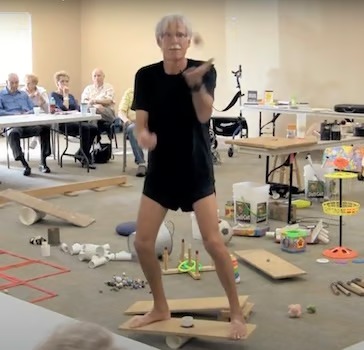
Stephen Jepson embodied this principle. Well into his seventies, he continued learning new physical skills, juggling patterns, balance challenges, and movement techniques, not because he needed them but because the act of learning itself was the point. Each new skill was proof that growth never stops.
Never Stop Growing
Explore more articles about the science of lifelong learning and personal growth.
Browse The 4 ThingsThe Bottom Line
Neuroplasticity does not expire. Your brain can build new connections at any age, and learning new skills is the most direct way to trigger that growth. Stacking multiple skills compounds the cognitive benefits beyond what any single activity can achieve. Learning with others adds social neuroprotection that solitary practice misses. And the psychological renewal of being a lifelong learner may be the most valuable benefit of all. The myth of the fixed adult brain is dead. The only question is what you will learn next.